01Order path
From target book to broker order
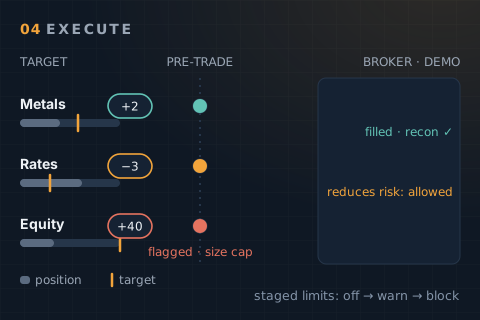
The Nexus overview shows step 4 as orders passing staged limits on their way to the broker. This is the whole path, and every step of it runs every trading day.
- 1
Promoted book
An account trades only the research book promoted for it. If that link is unknown or wrong, new risk is removed and exits still go out.
- 2
Same sizing
The trader and research pin the same position engine, so a backtest and the live book can't disagree about how a signal becomes a position.
- 3
Checked
The book is built only when every input market's data is complete. A closed market takes no orders, and stakes are rounded to the broker's deal steps.
- 4
Sent
Every order passes the pre-trade limits. A flip is a close, then an open that is sent only after the close confirms.
- 5
Reconciled
Positions are checked against the broker before every cycle. Funding and fills are reconciled every night.
For your firmEvery trading day starts with a full-book dry run before the first slot, 78 of them since 24 August, so the day's orders are rehearsed before any reach the broker.
02Pre-trade limits
Limits that never trap a position
Every order is checked against size, notional and position limits, set for 122 scopes from a single instrument up to a whole asset class. The limits are staged from off to warn to block, and the next stage is switched on only when the evidence says it is safe.
- Size, notional, positionRuns
Maximum order size, maximum notional and maximum position are checked on every order, and any breach is written on the order record itself.
- Risk-reducing always passesRuns
No stage ever refuses an order that reduces a position, so a limit can't trap the book. The check still runs and is recorded.
- Price collarsRuns · warn
Each order's price is compared with an independently captured price, and unusable quotes are caught.
- Margin capRuns
A margin cap trims the plan or stops the run before anything reaches the broker. It has never had to fire in production, and a drill proved that it works.
- Early warningRuns
Alerts fire at 50% and 80% of a limit, with hysteresis so they don't flap.
- Block modeBuilt, tested
Block mode refuses a breach, and it refuses any instrument that has no limit set. It goes live only once a replay of real fills under block refuses nothing. The last replay still refused one real order, so production runs at warn.
03Brakes
Independent brakes, any one of which stops trading
- A kill switch that depends on nothing. It is a file, controlled from outside the trading process, and it needs no database and no application. If it can't be read, it counts as on. It is checked before every execution.
- A halt flag in the database. It has stopped 20 live runs.
- Automatic halts. An equity drop from peak freezes every order, exits included. A run of order failures or errors halts trading too.
- A dead-man switch. Trading halts after a set number of days without an operator sign-in.
- A latch for people. A repeated-execution latch stays on after the halt is cleared, until a person clears it.
- Flatten always works. Closing positions is a separate path that no brake blocks.
04Broker
One broker client, paced and measured
A single IG REST client places orders, confirms them and reads positions, for a demo or a live account by configuration. It starts on the demo endpoint, in dry run, unless it is told otherwise.
- Paced to the broker. It keeps within IG's rate limits, pausing and resuming within a shared allowance rather than failing.
- Confirmed, not assumed. Every order is confirmed with the broker, and its fills are linked to it: 780 confirmed orders so far.
- Getting cleaner. Broker rejections fell from 117 in July to none so far in October.
05Reconciliation
Reconciled before every cycle, and again every night
A reconciliation is only useful if it can stop trading. The position check can, and it has: 74 live runs were stopped because the books didn't agree or the check couldn't finish.
- Positions, before every cycleRuns
Positions are checked against the broker before each trading cycle, and a break halts the run. There have been 1,085 checks since 26 July. Since 15 September, 227 of 230 were clean.
- Book against researchRuns
A daily check compares the trader's book with research's targets. It has run 182 times and halted trading 3 times.
- Funding, nightlyRuns
IG transaction history is pulled every night and reconciled against the model's funding, and breaks are flagged for follow-up.
- Portfolio ledgerRuns
Fills sync into the portfolio ledger every night: 361 transactions over 53 runs since 23 August.
- Next-morning auditRuns
Each trading day is audited the next morning, 168 times so far.
- Broker statementsBuilt
Reconciliation against the broker's statements is built and has not run yet.
06Scheduling
Each market at its own exchange's time
A resident scheduler trades each of 37 markets at its local exchange time, in Chicago, New York and London, and stays correct across daylight-saving changes. It made 908 live runs over 90 trading days, from 7 July to 14 October.
- Idempotent. A slot that has already run doesn't run again.
- Dry run by default. Sending real orders is an explicit setting, never an accident.
- Data first. A market trades only when its inputs are complete.
- Rehearsed daily. A full-book dry run comes before the first slot of every trading day.
How it is scheduledEvery trading job is a systemd unit on the production host, with no separate job framework: Scheduled by systemd.
07Stated plainly
What runs, stated plainly
Each control is shown at the stage it has reached in production.
Runs today
- One position engine for research and trading, and a promoted book per account.
- A per-market scheduler, with a full-book dry run every trading day.
- Size, notional and position limits at the warn stage, recorded on every order, which never stop a risk-reducing order.
- The kill switch, the halt flag, automatic halts, the dead-man switch and the latch.
- Position reconciliation before every cycle, and nightly funding reconciliation and ledger sync.
Built, not yet switched on
- Block mode for order limits and price collars, which waits on a replay that refuses nothing.
- Broker statement reconciliation.
- A second demo account for testing several accounts at once, held in dry run.
Not built
- A second broker. An Interactive Brokers interface exists, but every call fails on purpose.
- Every broker order so far has been on IG demo accounts. No live account has placed an order, and going live is an operator decision that is still open.
- The brakes stop new orders. They don't cancel orders resting at the broker, close positions or end the broker session; flatten does the closing.
- Reconciliation reports breaks rather than claiming a clean record, and some funding breaks are open now.
- One broker (IG spread bets), one production host and one operator.
- This page describes the framework. It shows no trading results and makes no performance claim.
Sources, read 2026-10-15: the trader's order, account, schedule, scheduler-run, limit, reconciliation and drill records; the portfolio ledger's sync runs; the deployed versions of the trader and the research service; the trader's code and documentation on its main branch; and the handbook's status page.